
The Texas Tommy!
When veteran dancer Frankie Manning was asked one time about where the Lindy Hop came from, I remember him mentioning several dances that came before the Lindy. He then proceeded to demonstrate the One Step, the Texas Tommy/Breakaway, and the Charleston. I know (relatively) quite a bit about the Charleston and One Step but really very little about the Texas Tommy. Some years ago, I went to the best source I knew and asked my friend and dance historian Lance Benishek about it. Lance was passionate about dances of the Swing era and their precursors, very meticulous in his research and extremely careful about sharing accurate information. I do know Lance would find original dance manuals from the period of the dances heyday or just after and study their descriptions. Needless to say, by the time any dance reaches its heyday and becomes mainstream and taught in a dance school, it would have already been around for some years and is often a watered down, more socially acceptable version of its original form. It seems no-one really knows where the Texas Tommy came from exactly, except that possibly there was some early form of the dance being done in the African American community in Texas, and that the word Tommy referred to a prostitute. Around the turn of the century there was a big migration of the African Americans moving to large cities like San Francsico, ending up in the port area, where sailors, prostitutes and a large representation of the black community moved to an area known as the Barbary Coast. This area was famous during the beginning of the 20th century for its numerous drinking and dancing establishments where Ragtime music was all the rage. And it was here that the Texas Tommy (a Ragtime dance) grew up and developed.
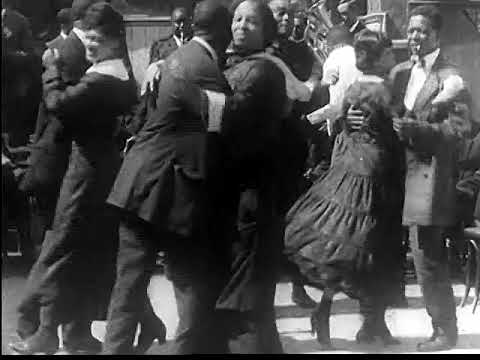
Of course with YouTube still some 90 years away, dance crazes never spread quite as quickly as they can do today: often a dance could be seen in some touring show where artists travelling from town to town would demonstrate their own version; they could have the same act for years before returning to the same theatre. Sometimes a dance could be described on the back of a song sheet, which became popular from the 1880s to the 1920s until the Talkies (early cinema as it was often referred to) took over, leaving quite a bit to the interpretation of the reader. So it was quite common that whilst the dance may have had the same name, it could vary tremendously from area to area. Eventually, through various performers spreading a show version of the dance across the states, the Texas Tommy ended up in New York, where it once again received some notoriety as a popular social dance but this time for younger people from all walks of life, looking for something new, exciting and rebellious.
The dance itself was popular around the same time as the Ragtime Animal Dances of the 1910-1914 and could be done in a close, almost cuddle-like embrace. However, unlike the One step and its animal variations, it didn’t travel anticlockwise around a ballroom floor (following a line of dance) but instead stayed in one place with its fast close hold rotations, step hop basic and some gliding sections. Importantly, it had a breakaway movement (i.e., going from a close hold embrace to an open position connected by only one hand) which of course we see later in the Lindy Hop.
Dance historians and enthusiasts can spend hours and hours poring over original dance manuals just to figure out a step. I knew a dancer who spent months learning one move from a manual, then proceeded to teach it to me in about 5 mins. Studying from a description is an artform in itself!
Lance showed me a series of 3 hop steps (with a resemblance to what I saw some years later demonstrated on an old silent movie and labelled the Turkey Trot), but in his version this was done in a close embrace, with the follows arm behind her back. The lead would then roll the follow out and back in, like the roll out we see in the Texas Tommy step in today’s Lindy Hop. I have also seen a similar type of ‘roll out and roll in’ demonstrated in various cabaret performances of the French dance Apache. Whilst a slightly older dance, the Apache was coincidentally being performed around the same time. (Here is a clip I found on YouTube from 1926 Apache Dance from “Sunshine of Paradise Alley” – please note that although this dance was a popular cabaret dance from the 1900s-1960s, today it can offend some people – so please make up your own mind on that side, I share this here as a historical record).
There is also a short, silent clip of the Texas Tommy from 1914 available from the Prelinger Archives of San Francisco citing variations of the Texas Tommy Swing Dance and Ballin’ the Jack. Notice the close embrace of the couples here is not dissimilar to the close embrace of the French Apache dance – perhaps somewhat less dramatic! However, in this particular clip, the Roll Out is not seen. Dance historian Richard Powers tells us the most famous of the African American Texas Tommy dancers – Johnny Peters from San Francisco and his partner Ethel Williams (who took over from his original partner whilst in New York after she had to pull out due to illness) – performed the Texas Tommy in New York around 1911 in a successful vaudeville act. They helped to popularise the dance into an easier social dance around New York including a version danced at the Savoy Ballroom (1926), which became home to the Lindy Hop by 1928. He also explains how if you watch Shorty George Snowden and his Savoy Ballroom dancers in the 1929 version of early Lindy Hop in “After Seben”, its Texas Tommy roots are apparent. So, the Lindy grew out of many of the dances that came before it and has always been a live, organic kind of dance borrowing ideas from wherever it could. When you look at the 1929 Shorty Snowden clip mentioned earlier, compare it to the Lindy done in the Marx Brothers movie Day at the Races (1937), then the famous Lindy scene in the film Hellzapoppin (1941) starring Olsen & Johnsen (all featuring Savoy dancers): the dance never stood still and was always changing. Just look at the Lindy (/Rock N Roll) dancing in the Rock Around The Clock (1956) for an even later take on the Lindy! I love all of these different styles – and if you can dance it to Swing music, and the dance itself swings, then I say let’s dance!
On a personal note, this research about the Texas Tommy has brought back early memories of teaching the Lindy Hop and specifically about learning movement/dance steps without a visual aid (other than some still pictures). I recall how about three months after I first went self-employed as a full time dancer in 1990, as I was out jogging, I slipped jumping over a step, as a result of which I was in plaster for 9 weeks with a broken bone, then recovering for a further 9 weeks, followed by having to build the muscles up again! At the very beginning, I arranged for some fellow teachers to stand in for me, or some senior students to demonstrate whilst I sat on the side and called out the steps, but every so often I was on my own and had to teach a class just calling out instructions. Before I was forced to do that, I didn’t think it would be possible! Until then, I was of the opinion that the teacher had to demonstrate the moves, but I learned how to describe what to do just with words and to my surprise it went remarkably well. On the strength of that, I wrote my book, Let’s Lindy (now sadly out of print) and over the years I regularly had people coming up to me saying how they had learned to dance from that book alone. I believe that early experience helped me to become a much better teacher.
Acknowledgements:
Home | Richard Powers Dance
Library of Dance – Texas Tommy includes a nice reference to afun clip :
1939, Fred Astaire and Ginger Rogers danced steps from the Texas Tommy in The Story of Vernon and Irene Castle, including the Swingout with Hand Change Behind the Back: Fred and Ginger – Waiting For The Robert E. Lee (youtube.com)